S.05 · Service
AI Chatbot Development
Embeddable AI chatbots that actually answer the question.
HOW WE WORK
The process we follow.
- 01
Ingest
We crawl your docs, sitemap, MDX, and uploaded PDFs. Embeddings stored in pgvector or Pinecone.
- 02
Tune
Eval set built from your actual support tickets. We benchmark accuracy + latency + cost across providers before picking the default.
- 03
Embed
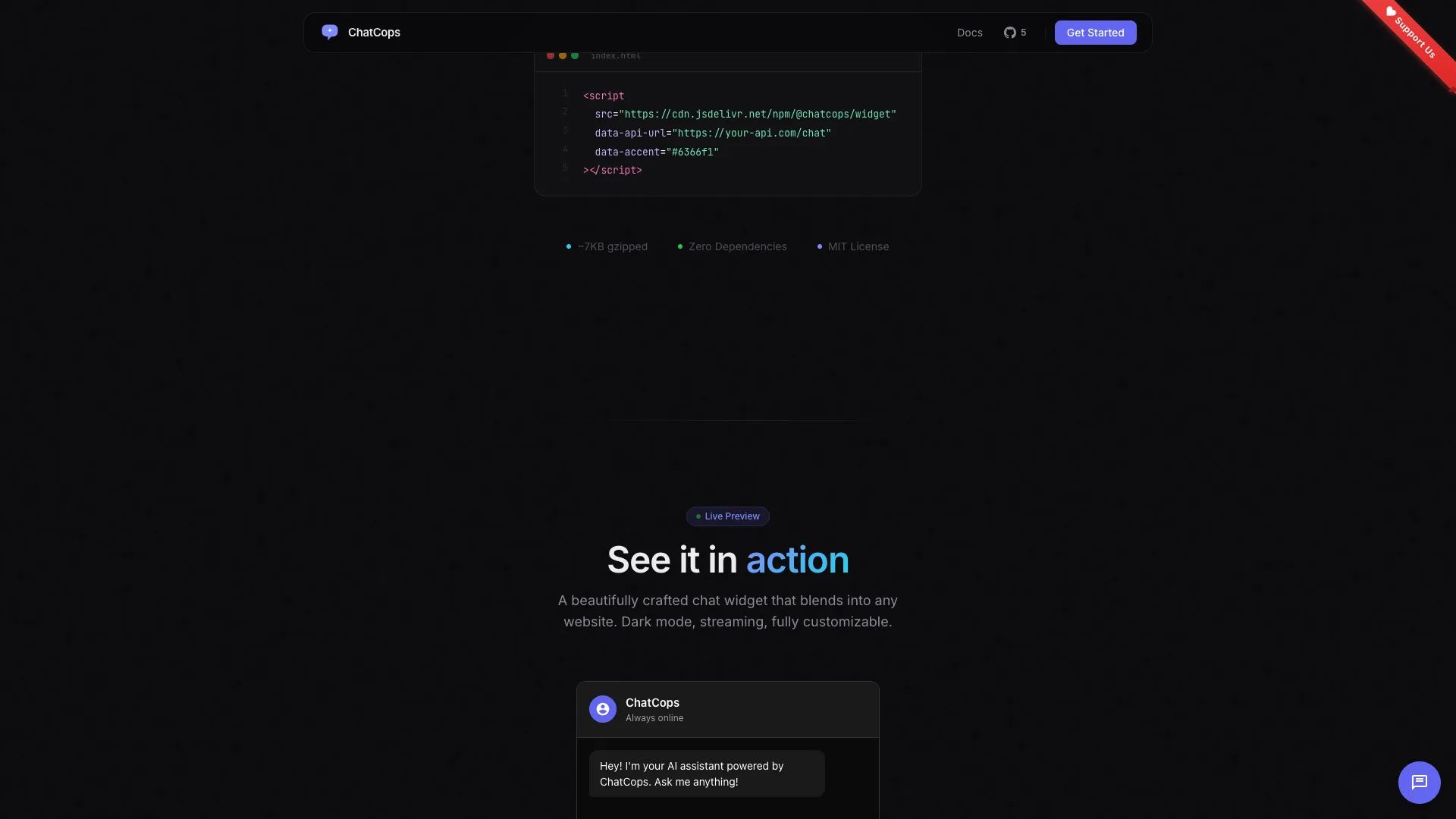
Single <script> tag on your site. Or self-host the widget. Or build it into your app's UI.
- 04
Iterate
Weekly dashboard of asked-but-failed questions. We patch the knowledge base, retrain, redeploy.
Every engagement is scoped and written down before we start.
Brief us →FIELD NOTES
What clients actually said.
“Finding someone who can actually ship LLM features in production is rare. The studio shipped, then helped me hire a verified builder for the rollout.”

Alex Chen
CEO · Lore Protocol
“Working with CODERCOPS was seamless. They understood the nuances of AI-driven interviews and built a product that feels incredibly human. Our users love the realistic experience.”

Sarah Johnson
Founder · PrepAI
“QueryLytic has democratized data access across our organization. Marketing, sales, and ops teams can now get insights without waiting for engineering. CODERCOPS delivered beyond our expectations.”

Michael Torres
CTO · DataFlow Analytics
BILL OF MATERIALS
The stack we trust.
Models
- Claude (Anthropic)
- GPT-4/5 (OpenAI)
- Gemini (Google)
- Llama (open)
Retrieval
- pgvector
- Pinecone
- Qdrant
- Embedding-cache
Frontend
- Vanilla JS widget (~7KB)
- React component
- Custom UI
Hosting
- Cloudflare Workers
- Vercel Edge
- Self-hosted
Boring choices on purpose. Plain-stack code outlives the consultant. If you have a stack already, we'll meet you there.
What we ship
A chatbot that does one job well: answer questions about your content, accurately, with citations.
Not a personality. Not a “delight” feature. Not a chatty marketing gimmick. A working tool that deflects support tickets, helps users find what they need, and tells you which questions your documentation can’t answer.
ChatCops — our open-source widget
For teams that want a chatbot up in days, not weeks, we maintain ChatCops — an open-source, embeddable AI chat widget. Drop one <script> tag, point it at your docs, ship.
It’s the foundation we use for most chatbot engagements. Custom builds extend it; simpler installs use it as-is with light theming.
How a custom chatbot is different
A custom chatbot lives inside your product, not on top of it. It knows the user, sees their data, can take actions on their behalf:
- An e-commerce chatbot that knows your order history, can issue refunds, can apply coupons.
- A SaaS copilot that can generate, edit, and save content directly in your product UI.
- A B2B assistant that pulls live data from your warehouse and answers analyst-grade questions.
These are different beasts from a docs chatbot, and we build them differently — agentic, tool-rich, observable end-to-end.
What’s included in every build
- Eval harness. Real questions from your support tickets, scored against expected answers. We can prove the accuracy went up after every prompt change.
- Cost dashboard. Tokens in, tokens out, $ per conversation, per user, per day. No more end-of-month API bill surprises.
- Drift monitoring. When your knowledge base updates, accuracy drops on questions about the new content until we re-embed. We catch this automatically.
- Provider abstraction. Switching from Claude to GPT to Gemini is a config change, not a rewrite. Useful when one provider raises prices or has an outage.
Common questions
Things people ask first.
If a question is in your knowledge base, it cites the source. If not, it says it doesn't know. We disable freeform answers from the model's training data — only your content matters.
Sub-2-second time-to-first-token on most providers, with streaming UI so users see characters appearing immediately.
Yes — tool-calling integrates with Zendesk, Intercom, Slack, or your custom helpdesk. The bot escalates intelligently.
Depends on traffic. Typical small site: $20–80/mo in API costs. Larger sites with 10k+ conversations: $200–500/mo. We provide cost dashboards.
Yes — modern LLMs handle 50+ languages well out of the box. We can ingest a multilingual knowledge base or rely on the model's translation capability.
More services
AI Chatbot for Ecommerce
A support and shopping assistant for online stores. Answers product questions, checks order status, handles returns and refunds, and recommends products, all grounded in your catalog and policies.
AI Development Services
Production LLM features — copilots, classifiers, content engines, agentic workflows. We pick the right model, write the right guardrails, and run the right evals so it still works on day 90.
Custom Software Development
Internal tools, B2B platforms, integrations, custom automations. Type-safe end-to-end. The kind of code your future engineering hire will thank you for.